Author: david

  • A new blog

    I’ve decided to start another blog. It’s called f1buzz.net and it’s about Formula One. Clearly I have too much time on my hands.

    I’ve started it because I’ve been looking for a good F1 blog to fill the long cold void between seasons and haven’t been that impressed with what I’ve found. The teams have their own sites as does the Formula One Administration and there are quite a few “news” sites like ITV and the BBC but there aren’t that many other good blogs around, at least not in comparison to the number of tech blogs. Probably the best is F1 Fanatic.

    I’m not an expert on F1 but I hope I can contribute something vaguely interesting at the same time as learning more about the sport myself and that this post will motivate me to keep at it.


  • NASA have some cool pictures

    I guess it’s to be expected. The guys at NASA obviously have more opportunity to take cool photos than I do but, boy, they have some really cool pictures in their archives.

    Check out this picture of the Space Shuttle Endeavour landing at the Kennedy Space Center or this picture of NASA research pilot Bill Dana watching NASA’s NB-52B ‘Balls 8‘ mothership thundering overhead after a flight in the HL-10.

    Naturally Bill Dana sounds like he had the Right Stuff. He was a project pilot on the hypersonic X-15 research aircraft and flew the rocket-powered vehicle 16 times, reaching a top speed of 3,897 mph (mach 5.9) and a peak altitude of 307,000 feet (technically, that’s in space!) In almost 40 years of distinguished service to NASA he received NASA’s Distinguished Service Medal and was awarded the Milton O. Thompson Lifetime Achievement Award by the Dryden Flight Research Center and the NASA Exceptional Service Medal.

    Cool guy.

  • PQII v MGS4

    Computer game promotional videos sure have changed in the last twenty years.

    Compare this promotional video for Police Quest II (with “Improved 3D graphics!”):

    with the trailer for the latest Metal Gear Solid game:


  • What’s left behind

    When someone dies what do they leave behind?

    They continue to exist in the hearts and memories of those who knew and loved them but there are also physical reminders. Perhaps a gift that was given or a photograph that was taken. These take on an even greater importance than when they were alive and become a kind of link to those who are gone.

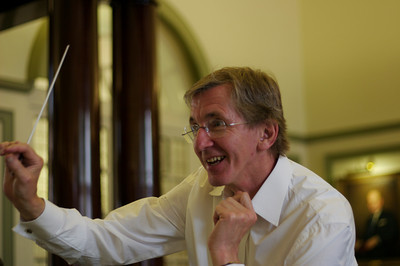
    When Alan had to take a break from conducting the CCO due to his treatment he came up to me after the final concert and gave me his stick he had just used. This old piece of cork and fiberglass with a chipped end is so important to me. If it was just any old baton that I had bought myself then I would probably throw it out and buy a shiny new one but it is more than that. It’s a personal connection to Alan. When I had to conduct the orchestra at short notice at the last concert I used this stick and it felt like in some way Alan was there too; his student conducting his orchestra with his stick.

    In the past it was just these personal objects that would remain but now we spend so much of our lives online there is a whole separate existence that remains on the web. When someone dies their blog or myspace page doesn’t suddenly stop. Their emails don’t suddenly disappear from your inbox and their contact details don’t vanish from your address book. If most of your contact with someone has been via email or the internet, as it so often is now, then it can be hard to accept that they are not there anymore. Perhaps their facebook page still shows events they are planning on attending. Their status message is permanently fixed.

    I was reading through some old emails the other day, many from or about Alan, and came across a link to his livejournal site. Alan used this as a way of communicating and recording his thoughts while he was receiving treatment in Calcutta, India in 2006. I’ve mirrored it on my website so I’ll always have a copy. There aren’t many posts but they are filled with his amusing comments on the strange existence he suddenly found himself in. He writes about his treatment, the house he stayed in and the people he met. Mostly he complains about the noise.

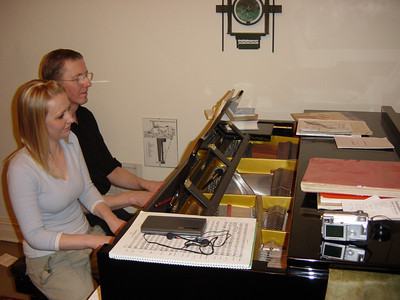
    Sometimes I find it hard to read but it is because it is so personal that I’m so glad I came across it again. It’s another reminder. Another weapon against forgetting. When I read his words complaining about the car horns, his drunk servant or his sore feet it is almost as if he is only away on a long trip and we’ll see him again soon for dinner at his cosy little flat where we’ll have some weird smoothie we’ll make from whatever Alan can find lying around. Maybe after dinner we’ll have tea and play duets on the piano until it’s time to go home.Duets at Alan's

  • Alan Hazeldine

    Alan HazeldineOur dear friend Alan died yesterday. After more than four years of continually surprising the medical profession he finally lost his battle with cancer.

    I first met Alan in 2000 after getting in touch through the Guildhall School of Music and Drama. I was looking for a conducting teacher and we arranged to meet at the Guildhall. I was a bit nervous but we talked about conductors and conducting and I waved my arms a bit to show him what I could do. He seemed to see some potential so we started the first lesson right then and there. It was in that first meeting that I learned one of the most important aspects of conducting: the idea that the arm needs to have a kind of ‘weight’ and it must move in a natural way as if guided by gravity, like a bouncing ball.

    From then on for about four years I would make the weekly trip up to Finsbury Park to Alan’s flat for our lessons. I remember being very excited to be studying conducting again and would make notes of everything. We studied scores and tried to work on my limited keyboard skills combining both by playing the Art of Fugue score in four different clefs on the piano. Alan impressed on me the importance of the conductor knowing about all the instruments in the orchestra, even to the point of being able to play each one. In this spirit I borrowed his trombone for a while but didn’t really succeed in making more than a few fumbling notes out of it.


    We would also discuss what I needed to do to further my conducting career but, like Alan, I always found the self promotion stuff hard. Each week he would ask “What news?” and I would usually have to sheepishly reply with some lame excuse about how busy I’d been at work. “JFDI, Just … Do It” he would say and I stuck this motto to my mirror to remind me every day. But if it weren’t for Alan I’m sure I never would have done as much as I have. It was only through his encouragement (and Kathryn’s support) that I started doing concerts in London. No matter how small the audience he was always there and encouraging. I remember at the first rehearsal for my first concert I arrived at St Giles to discover I had left half the music at home so while I started the rehearsal Alan and Kathryn made a dash in his car across London to fetch the music. This was Kathryn’s first experience of Alan’s unique driving style.

    Music is: A non-specific human language consisting of organised sound on a background of silence on a framework of time.

    Soon after starting lessons I joined his orchestra and this was a chance to not only play in a great band but also watch rehearsals. I would take my scores along to rehearsal and we would discuss how it went at lessons. I think I only did one concert before Kathryn also joined the orchestra. I know she was a bit afraid of Alan at first, worried that he would make her play something on her own but she soon realised he wasn’t as scary as she first thought. Over the years we three became close friends. On this day exactly three years ago Alan was there to see us become British citizens.

    I think Alan was always a bit disappointed that he didn’t achieve the same fame in his conducting career as his grouchy old teacher Sergiu Celibidache but there are more important things in life than fame. He made a lasting impression on hundreds of people; directly through friends, students, orchestra members and audiences, and indirectly through students passing on his influence and what he taught them. Eight years is quite a long time to know someone but at the same time not long at all.

    Alan Hazeldine, conductor, pianist and teacher was born on July 5, 1948. He died of cancer on November 10, 2008, aged 60.

    At Paul and Bonnie's wedding

  • el niño de las pinturas

    Granada graffitiA couple of weeks ago, on Miguel’s recommendation, we visited Granada. Granada was the last Moorish kingdom to hold out against the Christian monarchs (los Reyes Católicos) and this Moorish heritage permeates the city. Nowhere is it more apparent than in the Alhambra, a massive fortress built on a hill above the city.

    We stayed in the great Migueletes Hotel which is located in the old Moorish Albaicín quarter. This is a UNESCO World Heritage Site and is a maze of tiny winding cobbled streets on the north side of the Alhambra. The church of San Nicolás is located here and its square provides a stunning view of the Alhambra with the Sierra Nevada in the background. It’s fun to wander around these atmospheric streets where places like the lovely Plaza de San Miguel Bajo even have nice Coca-Cola signs.

    It was in the Albaicín that we first noticed some interesting graffiti. Apparently Granada is quite well known for its graffiti murals with the artist known as el niño de las pinturas being the most famous. I guess he’s kind of like a Spanish Banksy. Someone has even written a fifteen thousand word dissertation on him.

    Granada is a nice little city and well worth spending a couple of days in. Of course the Alhambra is the most obvious thing to see but there are plenty of other things to keep you occupied and Granada is one of the last places in Spain that still serves free tapas. I recommend the jamon y pimiento at Bodegas Castañeda on Almirecero!

  • Greece

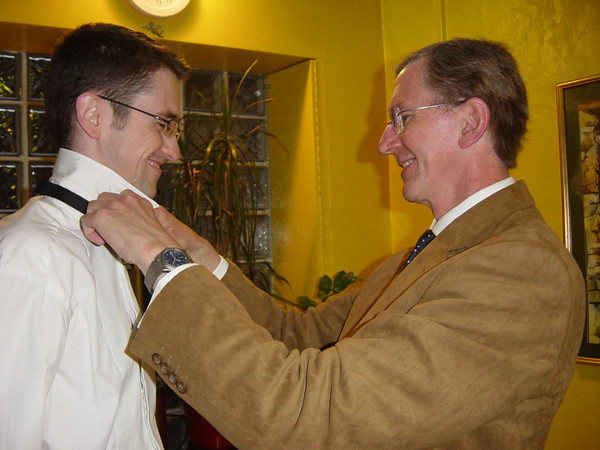
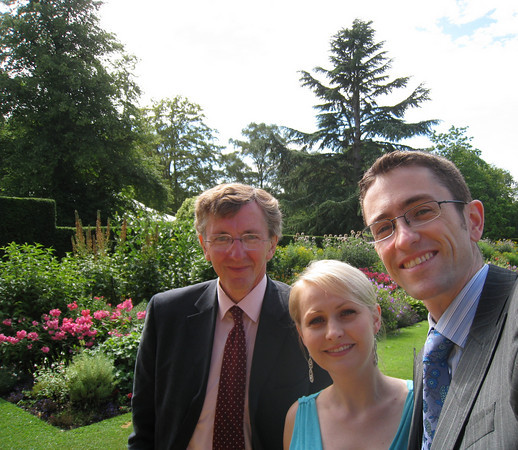
    The caldera2008 seems to be the Year of Weddings. There was Jonathan and Louise’s in July, Paul and Bonnie’s in August, Claire and Ed’s in October, Chloe and Kieran’s is in November and last month was Mark and Penny’s. That’s five weddings in as many months. Kathryn likes this because it means she has to buy five different wedding outfits. I, on the other hand, must suffer the shame of being photographed in the same suit at different weddings.

    So last month we caught Olympic Airlines flight OA270 to Athens to spend the week leading up to Mark and Penny’s wedding in Greece. We had skilfully booked the worst flight times possible so after a brief but refreshing three hours sleep at the Holiday Inn, Athens we boarded another flight at 5:45am to the island of Santorini.

    Also known as Thira, Santorini is a circular group of islands, part of the Cyclades in the Aegean sea. It is basically all that remains of one of the most cataclysmic volcanic eruptions in the history of the planet. In about 1650 BC a chain of eruptions shot thirty cubic kilometres of magma into the air causing the whole centre of the island to collapse and the sea to flood in and fill the caldera. It is believed the huge amounts of ash thrown into the air may have brought down the powerful Minoan civilisation in Crete one hundred kilometres away. People eventually moved back to the island but eruptions and earthquakes continued sporadically up until a major earthquake in 1956 destroyed most of the houses in the towns of Fira and Oia. Luckily for us, the locals rebuilt Oia into one of the most unique and beautiful villages on earth.

    Santorini sunsetWe arrived very early on a Sunday morning and as our room wasn’t ready we wandered into the centre of the village. A feature of Santorini, or at least Oia, is the large number of stray dogs. At first it was cute but by the time we were surrounded by about six barking dogs throwing themselves at the tyres of passing cars the novelty was starting to fade. We managed to lose the dogs and found ourselves at the ruined Kasteli (Castle) of Agios Nikolaos above the town. It was still only about 7am and we had the place to ourselves for a couple of hours as we watched the sun slowly creep up over the cliffs and light up the strange windmills pointing out to sea.

    We were in Oia for three nights and it is truly a unique and beautiful place. The bright white houses are perched on the top of red volcanic cliffs and the tiny streets are paved with marble. The distinctive blue domed churches seem to be around every corner and, just like Venice, you find yourself stopping to marvel at the view every few steps.

    We stayed in a little studio apartment called Strogili and it was fantastic. The view from our balcony where we had breakfast every morning looked straight out over the caldera. We quickly lost track of time as we drifted between breakfast, the pool, a stroll into town and dinner. Oia supposedly has the best sunset on Earth and every night people from all over the island fill the streets of the town to watch. I don’t know if it is the best but it certainly is beautiful as the sun sinks into the sea and the sky fades to orange.

    QuadOne day we hired a quad bike and rode to the main town of Fira. Fira is still amazing and if we hadn’t come from Oia we would have thought it was spectacular but it’s just not as nice as Oia. It is much busier and generally more touristy as Fira is where all the big cruise ships dock so there is a constant stream of day-tripping tourists. It’s worth a visit but staying in Oia is definitely recommended. We took the long road back via the southern beaches.

    Oia also has one of the most perfect bookshops in the world. Atlantis Books was started in the basement of one of Oia’s traditional houses by a couple of friends who found themselves on Santorini with not much to read. The bookshelves are all hand made and the staff rotates throughout the year, living in the bookshop itself. When we visited I had to go through into the kitchen to pay by card where I was offered a sample of the pancakes being cooked for dinner that night. The shelves are stocked with lots of interesting books but I wanted something suitably Hellenic so I bought a copy of Zorba the Greek.

    After the serenity of Oia Athens came as a bit of a shock. We were there for two days which I think is about the right amount of time. Of course the Acropolis is the main thing to see there but I found it a bit overrated. Maybe it’s because it was crawling with thousands of tourists, or maybe it’s because we nicked the best bits off the Parthenon. Actually there are a some other really interesting things to see in Athens besides the Acropolis. I thought the Temple of Olympian Zeus was good (and far less crowded) and the National Archaeological Museum of Athens is a very good museum.

    Xylocastro WeddingFrom Athens it was finally on to Xylokastro for the wedding. Xylokastro is a lovely little seaside town in the Peloponnesus about 40 km west of Corinth. The beach at Xylokastro is stunning with the most pristine, warm, clear water I have ever seen. Here we spent a fantastic few days with Mark and Penny, Jonathan and Louise and the Monkey. The wedding itself was unlike any wedding I’ve been to before. It started as the sun went down and the celebrations didn’t finish until much much later…

    Before this trip Greece had never been very high on our list of places to visit but we had such a great time; relaxing on Santorini, exploring in Athens and spending time with friends and family in Xylocastro and of course eating fantastic Greek food everywhere!

    Some holidays are over in a few days but others stay with you for a long time.

  • Eames Lounge Chair

    Dinosaurs and Robots posted a couple of great videos of Charles and Ray Eames being interviewed on the Arlene Francis “Home” show in 1956. Being the 1950’s, Ray is portrayed more as the supportive wife rather than the collaborating artist but they are fascinating to watch. I love the cinematic score that accompanies the unveiling of the Lounge Chair at about 3:40 in part 2!

    One day I hope to put my feet up in my own Eames Lounge…

  • 662 photos

    SkiddawI’ve been rinsing my internet connection uploading loads of pictures to the gallery.

    Back in June we had our yearly long weekend in the Lakes. Usually we go for a few moderately easy walks around the Fells but this year we decided to walk up a mountain. With its summit at 3,054 feet, Skiddaw is the fourth highest mountain in England. And it is one helluva climb. It was basically two hours of going up. When we stopped for lunch at Little Man the clouds suddenly descended on us and we found ourselves surrounded by mist. Despite the danger of plummeting 3000 feet to a stony death we pressed on grimly, occasionally passing fellow walkers as they loomed out of the whiteness. When we finally reached the summit, the clouds parted for a while giving us a muted but still impressive view over the fells. We couldn’t quite make out Ireland or the Isle of Man though…

    Coming down was probably harder than going up; a winning combination of endless pounding on the knees and constant danger of slipping and falling on something sharp. It was fun. Really.

    The next day we aimed for something much more relaxed. Starting in Keswick we wandered around the beautiful Derwent Water and up to Castlerigg Stone Circle finishing with one of the most amazing panoramas in the Lakes at Castlehead.

    Jonathan & Louise's weddingIn July it was Jonathan & Louise’s wedding at the beautiful old Saxon church at Breamore. This was followed by a totally awesome reception at Lodge Farm which culminated in a huge fireworks display that destroyed a couple of tables. I love fireworks.

    We left the day after the wedding to meet up with Carl and Jill in Venice, which by coincidence was the same place Jonathan and Louise were going on honeymoon! It was fun to catch up with them one night to see a concert of Vivaldi’s Four Seasons (natch).

    Venice was the first place we visited abroad when we came to the UK and it’s just as wonderful now as it was then. It’s still the kind of place where you can pop into a random church in some quiet campo and find that it turns out to be San Zaccaria which contains the body of John the Baptist’s father, is stuffed with the most amazing works of art including Bellini’s Sacra Conversazione and sneak down some stairs and you come across an incredible permanently flooded crypt. This time we also had a bit more money, so we could afford two of the other kind of Bellini’s at Quadri’s this time instead of having to share one between us.

    We stayed at a fantastic hotel in the Dorsoduro called La Calcina. From February 13 to May 23, 1877, John Ruskin stayed there and it is in a nice quiet area on the Giudecca Canal. They also have a roof terrace which you can book to have breakfast and gives an amazing view over the canal.

    Venice water taxiWe visited the excellent Peggy Guggenheim Collection, we saw lace making on the colourful island of Burano , we saw glass making (and spent way too much money) at a glass factory on Murano, we visited the sublime cathedral of Torcello and took in the view from the tower of Palladio’s magnificent San Giorgio Maggiore.

    Despite the tourists La Serenissima is still like nowhere else on Earth and what better way to leave than by speedboat with the wind in your hair and the sun setting across the lagoon.